
Modular Clinical LIMS Software & Diagnostic Operations Architecture
From specimen accessioning and barcode/RFID tube tracking to bi-directional analyzer interfacing and pathologist digital sign-off, AILS delivers an integrated clinical LIMS system for independent labs and hospital networks.
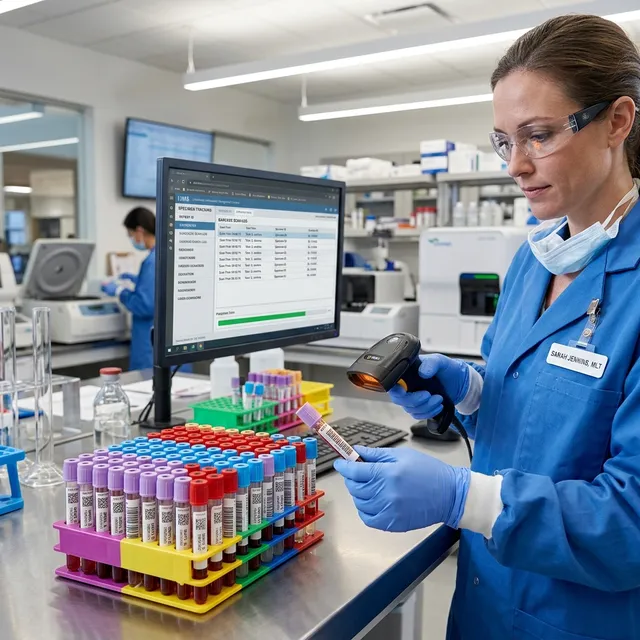
Specimen Accessioning & Barcode / RFID Tube Tracking
Eliminate pre-analytical errors with automated sample tube labeling (Code 128, 2D DataMatrix, and UHF RFID rack tracking). Track sample collection timestamps, phlebotomist identity, transport temperature, and automated rejection logging for hemolyzed, lipemic, or clotted specimens.
- ✓ Direct thermal barcode printer support (Zebra, TSC, Citizen)
- ✓ UHF RFID rack scanning for batch specimen check-in
- ✓ Documented sample rejection audit trail (ISO 15189 / NABL ready)
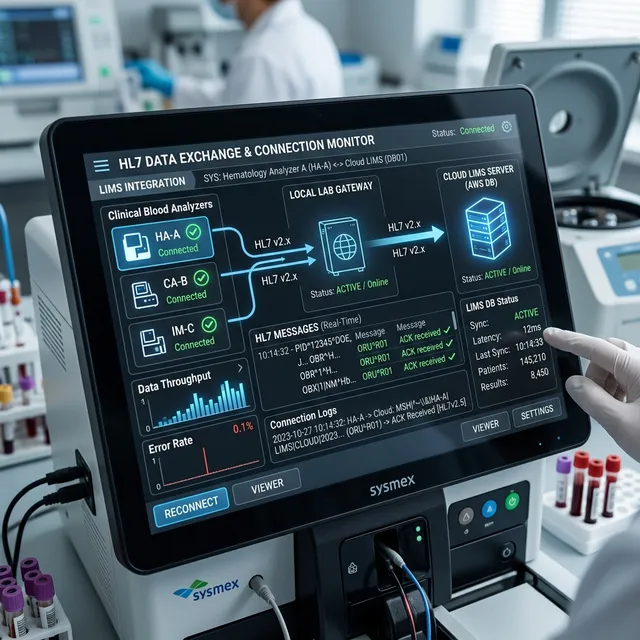
Multi-Instrument Bi-Directional Interfacing Engine
Connect 50+ hematology, biochemistry, immunoassay, and coagulation analyzers in real-time. Automated bi-directional host queries download test worklists on barcode scan and stream analytical results directly to patient charts with zero manual data entry.
- ✓ HL7 v2.3.1 / v2.5.1 MLLP TCP socket listeners
- ✓ ASTM E1381 / E1394 (CLSI LIS01/LIS02) RS-232 serial daemons
- ✓ Bi-directional Host Query mode with <200ms response time
Pathology Test Master & Universal LOINC Dictionaries
Maintain standardized clinical test directories with pre-configured LOINC codes, multiple units of measure (Conventional / SI), age- and gender-stratified biological reference ranges, and critical panic value limits.
Interoperable Coding
Every test parameter maps to universal LOINC identifiers for seamless electronic health record (EHR/EMR) exchange.
Demographic Stratification
Configurable normal ranges based on pediatric, adult, geriatric, male, female, or pregnancy trimester parameters.
Critical Value Alerts
Instant visual flags and SMS alerts when life-threatening results breach defined clinical boundaries.
AI Delta Checks & Automated Westgard QC
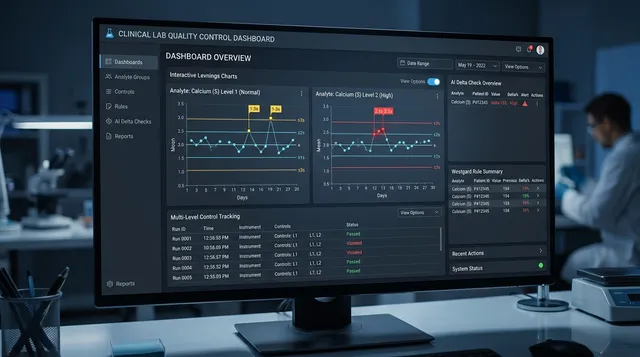
Prevent diagnostic errors before reports leave the laboratory. The AI delta check engine compares current patient values against historical records, while the QC module generates real-time Levey-Jennings charts with Westgard multirule evaluations (1-2s, 1-3s, 2-2s, R-4s, 4-1s, 10-x).
- ✓ Historical patient delta check flagging with rate-of-change thresholds
- ✓ Automated Levey-Jennings visual trend charts and SD calculation
- ✓ Multi-level control lots (Low, Normal, High) tracking
Pathologist E-Signatures & Anti-Fraud QR PDFs
Empower pathologists to verify and sign reports remotely. Automated high-resolution PDF rendering generates reports with cryptographically secured anti-fraud QR codes, auto-dispatched via WhatsApp, SMS, and Email.
Multi-Branch Billing & Turnaround-Time Telemetry
Streamline front-desk invoicing, referral doctor commission tracking, corporate B2B credit accounts, and real-time Turnaround Time (TAT) analytics from sample collection to report authorization.
Clinical LIMS Software Architecture & Implementation FAQs
What modules are included in modern clinical LIMS software?
A full-featured clinical LIMS software suite includes Specimen Accessioning with Barcode/RFID tracking, Multi-Instrument Bi-Directional Interfacing (HL7/ASTM), Pathology Test Master with LOINC coding, AI Delta Checks & Westgard QC, Pathologist E-Signatures, and Multi-Branch Billing with TAT telemetry.
How does barcode and RFID integration improve clinical laboratory operations?
Barcode (Code 128 / 2D DataMatrix) and UHF RFID integration automates sample accessioning and tube rack identification. Scanning verifies patient demographics, ordered panels, tube type, and collection timestamps—eliminating sample mix-ups.
Can AILS clinical lab management software support multi-branch diagnostic chains?
Yes. AILS is a cloud-native clinical LIMS system engineered with multi-tenant and multi-branch support. Central reference laboratories can manage satellite collection centers, phlebotomist field dispatch, sample courier logistics, and centralized pathologist verification from one dashboard.
How does the AI Delta Check module detect patient result anomalies?
The AI Delta Check module evaluates incoming test values against historical patient records. If a parameter exceeds standard physiological rate-of-change thresholds, the system flags the result for mandatory manual pathologist review before authorization.
Ready to Upgrade Your Clinical Laboratory Management Software?
Start with our Free Forever plan (no credit card required) or connect your diagnostic analyzers via our bi-directional HL7/ASTM middleware today.