
Abbott Alinity i Bi-Directional LIS Interfacing Guide
Technical interfacing guide: bi-directional query, sample aspiration verification, and certified driver configuration for Abbott Alinity i.
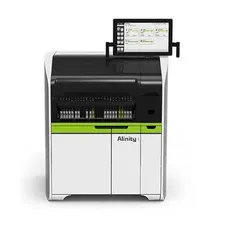
1. Abbott Alinity i Diagnostic Architecture & Clinical Use
In high-volume clinical pathology environments, the Abbott Alinity i (Abbott Diagnostics) provides robust Immunoassay diagnostic capabilities designed for Next-generation high-throughput immunoassay platform with continuous loading and optical barcode recognition.. Interface connectivity via AILS Gateway activates bidirectional sample accessioning, automated dilution factor management, and real-time result dispatch up to Up to 200 tests/hour. The system strictly conforms to physical interface requirements (Gigabit Ethernet RJ45) and official manufacturer guidelines (Abbott Alinity i System Operations Manual).
Emergency STAT specimens loaded onto the Abbott Alinity i trigger high-priority interrupt queries in AILS Gateway. The system pushes STAT test profiles to the top of the analytical queue without interrupting ongoing routine batches, sustaining high processing speeds up to Up to 200 tests/hour.
Preanalytical sample integrity alarms, clot alerts, and spectrophotometric serum indices (Hemolysis, Icterus, Lipemia) reported by the Abbott Alinity i are evaluated by AILS clinical logic. Tests susceptible to optical interference are automatically placed on review hold.
2. Abbott Alinity i TCP/IP Socket & Network Configuration
Gigabit Ethernet RJ45 | Settings: 1 Gbps TCP/IP (Configurable socket port). Handshake: Bi-directional HL7 order query (QRY^Q02) and observation report (ORU^R01)
[Abbott Alinity i Ethernet IP]            [AILS Gateway Socket Router]
IP Assignment: Static / Fixed DHCP <=======> Listening Host IP: 192.168.1.X
Target Port: Port 5000 / 5100 MLLP
Frame Start: <VT> (ASCII 0x0B)    --------> Buffer Allocation
Frame End:   <FS><CR> (0x1C 0x0D) --------> Checksum & Commit Record
Handshake:   Bi-Directional Commit ACK / DSR^Q03 Query-Response
3. Abbott Alinity i HL7 v2.x Message Stream
Below is a validated communication frame transmitted between the Abbott Alinity i and AILS LIS middleware:
MSH|^~\&|Abbott_Alinity_i|Abbott|AILS_GATEWAY|CENTRAL_LAB|20261030121800||ORU^R01|MSG_50048|P|2.5
PID|1||PAT842048||DOE^PATIENT_48||19840512|M
OBR|1|ORD_ACC20261048|ACC20261048|Abbott Alinity i^Profile|||20261030121800
OBX|1|NM|1834-1^AFP^LN||9.96|ng/mL|< 7.0|N|||F|||20261030121800
OBX|2|NM|2857-1^PSA^LN||6.72|ng/mL|< 4.0|N|||F|||20261030121800
OBX|3|NM|21198-7^BHCG^LN||7.80|mIU/mL|< 5.0|N|||F|||20261030121800
OBX|4|NM|3016-3^TSH^LN||2.83|uIU/mL|0.40 - 4.50|N|||F|||20261030121800
OBX|5|NM|3024-7^FT4^LN||3.26|ng/dL|0.80 - 1.80|N|||F|||20261030121800
OBX|6|NM|3053-6^FT3^LN||4.88|pg/mL|2.30 - 4.20|N|||F|||20261030121800
4. Abbott Alinity i Clinical Parameter LOINC & Reference Range Dictionary
| Instrument Code | LOINC Code | Clinical Parameter Name | Standard Units | Default Reference Range |
|---|---|---|---|---|
| AFP | 1834-1 | Alpha-Fetoprotein | ng/mL | < 7.0 |
| PSA | 2857-1 | Total Prostate Specific Antigen | ng/mL | < 4.0 |
| BHCG | 21198-7 | Beta-hCG Quantitative | mIU/mL | < 5.0 |
| TSH | 3016-3 | Thyroid Stimulating Hormone | uIU/mL | 0.40 - 4.50 |
| FT4 | 3024-7 | Free Thyroxine (FT4) | ng/dL | 0.80 - 1.80 |
| FT3 | 3053-6 | Free Triiodothyronine (FT3) | pg/mL | 2.30 - 4.20 |
5. Abbott Alinity i Biomedical Engineering Field Notes & Troubleshooting
Verified against Abbott Alinity i System Operations Manual & Abbott Alinity ci-series LIS Host Interface Specification (HL7)
High-Dose Hook Effect Protection: High tumor marker or hormone concentrations on Abbott Alinity i can cause antigen excess hook effects. AILS LIMS flags unexpected normal results for reflex auto-dilution.
Wash Buffer & PMT Calibration: Ensure substrate wash nozzles on Abbott Alinity i are free of salt buildup. Baseline photomultiplier tube (PMT) dark current must fall within tolerances specified in Abbott Alinity i System Operations Manual.
HL7 / ASTM Message Mapping: The Abbott Alinity i transmits chemiluminescent Relative Light Units (RLU) and calculated concentrations (High-sensitivity cardiac markers, HIV Ag/Ab combo,...). Confirm LOINC code mapping in AILS master catalog.
STAT Tube Priority Lane: When loading emergency samples on Abbott Alinity i, utilize the dedicated STAT rack position to allow AILS Gateway to prioritize accession lookup in sub-200ms.
Reagent Lot Calibration Verification: When loading new reagent lots on Abbott Alinity i, verify that master calibration curve barcodes are scanned and validated against Westgard rules in AILS LIMS.
Frequently Asked Questions: Abbott Alinity i LIS Interfacing
Common biomedical engineering questions regarding connection, worklist setup, and data capture with AILS Cloud LIMS.
Q: What are the exact communication port settings for the Abbott Alinity i interface?
The Abbott Alinity i connects via Gigabit Ethernet RJ45 operating under HL7 v2.5 / v2.5.1 TCP MLLP. For network configurations, configure the instrument with a static IP and point to the AILS Gateway socket listener on 1 Gbps TCP/IP (Configurable socket port). The driver maintains an persistent MLLP TCP socket with automatic reconnect.
Q: How are patient sample barcodes processed between Abbott Alinity i and AILS LIMS?
Specimen barcodes are scanned as tubes enter the aspiration station. AILS Gateway verifies the accession number and transmits assigned panels (High-sensitivity cardiac markers, HIV Ag/Ab combo, Hepatitis...) to the analyzer firmware instantly.
Q: How are high-concentration samples and hook effects handled on the Abbott Alinity i?
AILS Gateway evaluates immunoassay results against historical patient baselines and clinical ranges. Unexpectedly low values on suspected high-titer specimens trigger automated reflex dilution workorders back to the Abbott Alinity i.
Q: How does AILS LIMS alert staff to critical panic results from the Abbott Alinity i?
Critical panic limits trigger immediate visual popups on laboratory dashboard screens and SMS alerts to attending physicians, creating a permanent timestamped audit trail compliant with ISO 15189.
Related Immunoassay Instrument Guides
Compare protocols, pinouts, and parameter mapping dictionaries for comparable diagnostic equipment.
Roche Cobas e411 (Elecsys)
Electrochemiluminescence immunoassay (ECLIA) analyzer for thyroid, hormone, tumor marker, cardiac, and infectious disease testing.
Roche Cobas e601 (Cobas 6000)
High-throughput electrochemiluminescent immunoassay module integrated into Cobas 6000 multi-analyzer line.
Snibe Maglumi 800
Compact Chemiluminescence Immunoassay (CLIA) analyzer using ABNI labeled magnetic nanoparticles.
Unify the Abbott Alinity i with Your Central Laboratory Network
Manage hematology, biochemistry, immunoassay, and coagulation analyzers across multiple branches on a single unified dashboard. AILS Cloud LIMS connects the Abbott Alinity i with seamless cross-analyzer delta checks and consolidated patient reporting.